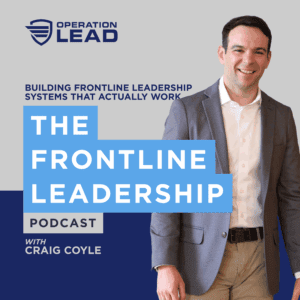
From the Lean Solutions Podcast
Promoting from within is a smart move.
It boosts morale, rewards high performance, and shows employees that growth is possible. But for too many organizations, promoting a great technician or operator into a leadership role quickly leads to frustration — for the new leader and their team.
Why?
Because being a good worker and being a good leader are two very different jobs.
I recently joined Patrick Adams and Catherine McDonald on The Lean Solutions Podcast to unpack one of the most common — and costly — problems I see in operations-based organizations: the frontline leadership gap. Below are some of the key insights from our conversation.
The Frontline Promotion Problem
When you promote a technician into a supervisor role, it often happens like this:
-
They’re a top performer — fast, reliable, detail-oriented.
-
The team is growing or an opening appears, so you move them into a leadership position.
-
Day 1 starts and… nothing happens.
No orientation. No development plan. No leadership playbook.
They just keep doing the work, except now they’re also responsible for people, schedules, standards, morale, and performance — often without clarity or support.
This isn’t a failure of the individual. It’s a failure of the system.
Why Traditional Leadership Training Falls Flat
Companies often try to close this gap by sending new supervisors to a one-day or two-day training course. The intention is right, but the format is wrong.
Why?
Because real leadership isn’t learned in a binder — it’s learned on the job, in the moments that matter:
-
When someone on the team is late… again.
-
When performance is slipping but no one’s talking about it.
-
When safety protocols are skipped to hit a deadline.
-
When a leader needs to hold the line and keep people engaged.
What new leaders really need is situational support, practical tools, and a clear framework they can use in real time — not after the fact.
Three Common Patterns That Hold Leaders Back
In the episode, we discussed three major reasons most frontline leadership development fails:
1. We treat leadership like it’s intuitive.
Most people believe that good leaders are just “naturals.” So when new leaders struggle, we assume they’re not cut out for it — instead of recognizing they’ve never been shown how to lead well.
2. We prioritize the work over the worker.
In operations, there’s always pressure to meet production goals. So even when a new leader starts to show signs of stress or burnout, the work keeps piling up. Over time, leadership becomes a burden — not an opportunity.
3. We train them like they’re executives.
Too much leadership training is built for upper-level management — not for frontline supervisors. What works in a boardroom doesn’t always apply on the shop floor.
The Shift: From Firefighting to Intentional Leadership Systems
What’s the alternative?
You don’t need more PowerPoint decks or generic leadership mantras. You need to build a simple, structured leadership system that helps supervisors lead well under pressure.
That includes:
-
Clarity: A defined set of responsibilities, behaviors, and outcomes expected from frontline leaders.
-
Tools: Playbooks, 1:1 templates, coaching guides — real tools they’ll actually use.
-
Support: On-the-job mentorship and feedback loops that meet them where they are.
-
Consistency: Reinforcement over time, not one-and-done workshops.
When you do this well, you unlock the real power of your frontline: engaged, capable leaders who take ownership of performance and culture.
The Real ROI of Better Leadership
As I shared on the show, operations leaders who invest in their frontline don’t just see better engagement. They see improvements in:
-
Retention
-
Quality
-
Throughput
-
Safety
-
Accountability
Why? Because people don’t leave jobs — they leave bad leaders. And great leaders don’t just show up. They’re built, intentionally.
Listen to the Full Conversation
If this hit home for you — if you’re seeing signs of disengagement, inconsistent performance, or weak accountability on your teams — I’d encourage you to listen to the full episode:



Then shoot me a message. I’d love to hear what challenges you’re seeing in your own operation — and what you’re doing to support the next generation of leaders.