Leadership Failure Isn’t a Talent Problem
Across manufacturing, nonprofits, and operations-heavy organizations, one pattern shows up again and again: high-performing employees are promoted into leadership roles, only to struggle, burn out, or leave within the first year or two.
This isn’t because those individuals lack motivation or intelligence. It’s because leadership is a fundamentally different role—and most organizations underestimate the magnitude of that transition.
In a recent conversation on Learning for Good, we explored why so many new leaders fail and what manufacturing organizations can learn from industries where failure simply isn’t an option, like aviation. The lessons apply far beyond the cockpit and offer a powerful framework for building leaders who don’t just survive—but thrive.
The Real Reason Two-Thirds of New Leaders Fail
It’s often cited that nearly two-thirds of new leaders fail or quit within their first 18 months. Most explanations stop at surface-level causes: lack of skills, poor communication, or weak confidence.
The deeper issue is more systemic.
Becoming a leader isn’t just learning new skills—it’s becoming a new version of yourself. For most of our lives, we’re trained to succeed as individuals. School, early careers, and performance systems reward personal execution. Leadership flips that model overnight. Success is no longer about what you do—it’s about what others do because of you.
That shift doesn’t happen automatically. Without intentional support, new leaders fall back on the habits that made them successful before. Unfortunately, those habits often do more harm than good in leadership roles.
Insight #1: Leadership Transitions Are a Change Process—Not an Event
Most organizations treat leadership promotion as a moment: announce the role, provide a short training, and move on. But leadership transitions follow the same emotional and behavioral arc as any major change.
New leaders often start with excitement and optimism. Within months, reality sets in. Confidence drops. Frustration rises. This “valley” is where many leaders disengage or fail.
Without recognizing leadership as a change journey, organizations unintentionally abandon leaders at the most vulnerable point—when encouragement, normalization, and guidance matter most.
Insight #2: Aviation Gets Leader Development Right—Here’s Why
In aviation, performance expectations are high because the consequences of failure are clear. Pilots don’t rely on motivation alone; they rely on systems.
Three elements consistently show up in aviation training—and are often missing in leadership development:
1. Structure
Clear standards, repeatable processes, and defined expectations. Pilots know exactly what “good” looks like. Many leaders don’t.
2. Guidance
Pilots don’t train alone. Certified instructor pilots coach, observe, and correct. In leadership, guidance might look like coaches, mentors, or experienced leaders intentionally supporting those who are new.
3. Community
Pilots train in cohorts. They learn together, struggle together, and hold one another accountable. Leadership, by contrast, is often isolating—especially for first-time managers.
When these three elements work together, development accelerates and confidence grows.
Insight #3: Community Is the Missing Multiplier
Of the three elements, community is the most overlooked—and the most powerful.
Leadership is hard enough without feeling alone. When new leaders only interact with their direct reports or senior leaders, self-doubt grows quickly. Community normalizes the struggle and reinforces that challenges are part of the journey—not a personal failure.
Some organizations push back, worrying about competition or limited headcount. But an abundance mindset changes everything. When leaders grow together, the entire organization benefits. The collective capability increases far more than any individual advancement ever could.
Insight #4: Tactical Training Isn’t Enough—Leader Development Must Be Strategic
Many organizations approach leader development tactically: lists of skills, workshops, and one-off training events. While those have value, they miss the bigger picture.
Effective leader development starts with strategy:
-
What is the organization trying to accomplish?
-
What behaviors are required on the front lines to make that happen?
-
What kind of leaders are needed to reinforce those behaviors daily?
When strategy drives development, structure becomes clear, guidance becomes intentional, and community forms naturally around shared purpose.
Insight #5: Early Wins Build Belief
One of the fastest ways to derail a new leader is overwhelming them with complexity. Confidence matters early—and confidence is built through small, visible wins.
Providing simple tools—like a clear checklist for the first 30–90 days—gives leaders something to anchor to. Early wins reduce imposter syndrome, reinforce belief, and create momentum for deeper growth.
Leadership development isn’t about perfection; it’s about progress.
Why This Matters for Manufacturing Leaders
Manufacturing environments demand consistency, accountability, and trust. Frontline leaders shape engagement, safety, quality, and retention every day. When they struggle, the entire operation feels it.
Organizations that invest in structured, supported, and community-driven leader development don’t just reduce failure rates—they create cultures where leaders want to stay, grow, and contribute.
Want to Go Deeper? Listen to the Full Podcast Episode
This article only scratches the surface. In the full Learning for Good podcast episode, we dive deeper into:
-
Applying aviation principles to leadership development
-
Supporting new leaders through the most difficult phases of transition
-
Building sustainable systems—not just training programs
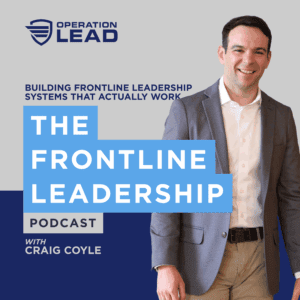
🎧 Listen to the full episode of Learning for Good featuring Craig Coyle to explore how structure, guidance, and community can transform leadership development in your organization.