Manufacturing leaders are facing a paradox.
On one hand, organizations are investing heavily in technology, automation, and systems designed to improve efficiency and output. On the other hand, many are still struggling with disengagement, turnover, burnout, and inconsistent performance.
The common denominator isn’t equipment or process.
It’s leadership.
More specifically, it’s how leaders—especially frontline and first-time leaders—are developed.
In too many organizations, leadership is treated as a promotion, not a profession. And the downstream cost of that assumption is far greater than most companies realize.
Why So Many Leaders Struggle Early—and Quietly
Research consistently shows that a majority of new leaders struggle in their first years. Some leave leadership entirely. Others stay—but operate in survival mode, battling imposter syndrome, skill gaps, and emotional exhaustion.
The issue isn’t effort or intent. Most new leaders want to do a great job.
The issue is that the skills that make someone successful as an individual contributor rarely translate into leadership success. In fact, applying those same instincts—doing more yourself, fixing problems personally, pushing harder—often makes things worse.
Leadership requires a different operating system. And without guidance, most people are left to figure it out alone.
Accidental Bosses and the Risk to Organizational Culture
In manufacturing, this problem is amplified.
Frontline supervisors and first-level managers typically account for roughly 80% of leadership touchpoints within an organization. Yet a large percentage of them would describe themselves as accidental bosses—leaders who never intended to lead but accepted the role as the next step in their career.
When organizations fail to intentionally develop this population, culture becomes a gamble.
Values are inconsistently modeled. Expectations are unclear. Engagement varies by department. And senior leaders are forced into constant firefighting instead of strategic leadership.
Leadership shouldn’t be guesswork—especially at the level that most directly shapes the employee experience.
Leadership Is Built in Preparation, Not Pressure
One of the biggest myths about leadership is that great leaders simply “know what to do” in the moment.
In reality, the opposite is true.
In high-stakes professions—aviation, medicine, the military—performance under pressure is the result of deliberate preparation. Pilots don’t rely on instinct alone. They train for scenarios they may never encounter. They study failure modes. They rehearse decisions long before they’re required to act.
Leadership should work the same way.
The quality of a leader’s response in a difficult moment isn’t determined by personality—it’s determined by the work they’ve done beforehand.
What Manufacturing Can Learn from Aviation Checklists
Aviation relies on checklists for a reason: they reduce risk, increase consistency, and eliminate preventable failure.
Leadership benefits from the same discipline.
When leadership development is structured around clear frameworks—mission clarity, role alignment, scenario planning, system checks, and self-awareness—leaders stop reacting emotionally and start responding intentionally.
This doesn’t oversimplify leadership. It supports it.
For new leaders especially, clarity creates confidence. It replaces fog with direction and transforms leadership from something overwhelming into something actionable.
The Overlooked Skill: Self-Management Under Pressure
One of the most underestimated aspects of leadership is emotional readiness.
Life doesn’t stop when someone is promoted. Stress, family challenges, fatigue, and uncertainty all show up at work—whether leaders acknowledge them or not.
The most effective leaders develop the discipline to pause, self-assess, and recognize when personal factors could influence their decisions. That awareness prevents reactions that damage trust and credibility.
Culture isn’t defined by intentions.
It’s defined by how leaders show up when things get hard.
Dream Jobs Don’t Automatically Create Dream Lives
Many leaders assume that achieving a dream role will lead to fulfillment. Experience often proves otherwise.
What truly determines job satisfaction isn’t the title—it’s the environment. The leader you work for. The trust you feel. The clarity you’re given. The sense that your work matters.
For manufacturing organizations, this presents a massive opportunity.
Companies that invest in leadership development don’t just improve performance—they improve lives. They create environments people want to be part of. And in an industry competing fiercely for talent, that difference matters.
Change Requires Community, Not Just Training
Leadership development isn’t transactional—it’s transformational. And transformation doesn’t happen in isolation.
People sustain change when they’re surrounded by others pursuing the same growth. Community reinforces new habits, provides accountability, and prevents leaders from slipping back into old patterns.
Without it, even the best training fades. With it, leadership development compounds.
Organizations that intentionally build leadership communities don’t just develop better leaders—they create momentum that spreads across teams and departments.
Want the Full Conversation? Listen to the Podcast
This article captures the why behind professionalizing leadership—but the full conversation goes deeper into the how.
🎧 Listen to the full episode of the Manufacturing Employer Podcast:
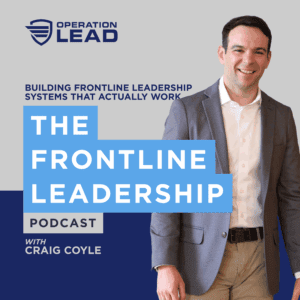
👉 Lead Like a Pilot with Craig Coyle of Operation Lead
In the episode, we explore:
-
Why leadership fails so often despite good intentions
-
How aviation principles translate directly to manufacturing leadership
-
The role of preparation, checklists, and community in leader success
-
How organizations can reduce chaos and unlock workforce potential
If you’re responsible for developing leaders—or feeling the impact of leadership gaps—this episode is worth your time.