60% of new leaders and managers fail within their first 18 months.
Six out of every ten people promoted into leadership positions struggle, burn out, or flat-out fail before they hit the two-year mark.
If you’ve ever been promoted into leadership and felt like you were drowning—working longer hours, firefighting constantly, watching your best people disengage—you’re not alone.
And more importantly, it’s not your fault.
The Problem No One Talks About
Here’s what I believe, and what I don’t see anyone else saying clearly enough:
The problem isn’t the people. It’s the system.
We promote talented individual contributors into leadership roles based on their technical skill or tenure. Then we hand them a team, wish them luck, and expect them to figure it out on their own.
And when they struggle? We blame them.
But let me ask you this:
If 60% of pilots failed their flights, would we blame the pilots—or the training system?
If 60% of bridges built by engineers collapsed, would we say they weren’t “engineering material”—or would we question how they were developed?
If 60% of surgeries were unsuccessful, would we shrug and say “leadership just isn’t for everyone”?
Of course not.
We’d recognize immediately that something is fundamentally broken in how we’re preparing people for that role.
Yet in leadership, we accept a 60% failure rate as normal. We call it “paying your dues” or “learning on the job.”
It’s time we stop accepting that.
My Story: Falling Flat on My Face
I know what it feels like to be that statistic.
I was privileged growing up—not in the sense of wealth, but in opportunity. I had access to excellent education, played multiple varsity sports, and worked hard enough to become valedictorian of my high school class.
That success opened the door to West Point, where I continued to excel. I graduated as an aerospace engineer, succeeded militarily and physically, and earned my dream: flight school.
Two years later, I was flying Apache helicopters. I had achieved everything I’d worked for.
Then I became responsible for leading a team of about 15 pilots and maintainers at Fort Bragg.
And I fell flat on my face.
Within six months, I was stressed, burned out, and ready to give up my entire dream. I was miserable.
Morale across the organization was in the basement. People were going through the motions. I was working 16-18 hour days, barely flying—the very thing I’d pursued leadership to do more of.
And I had no idea what I was doing wrong.
Here’s what I didn’t understand at the time: What makes you successful as an individual is often what holds you back as a leader.
I could operate the equipment. I could analyze data. I could execute any task asked of me.
But I couldn’t figure out why our best maintainers were disengaged. Why pilots clocked in and clocked out with no energy. Why team meetings felt like interrogations. Why it felt like no one had purpose or motivation.
I had been given the opportunity to lead because I was successful as an individual.
But success as an individual had no correlation to success as a leader.
I was taught exactly how to manage expectations, requirements, and equipment.
But leadership is a completely different job.
And no one told me how to do it.
You Are Not Alone
My story isn’t unique. Not even close.
In plants, warehouses, factories, hospitals—name the industry—individuals are getting promoted into leadership every single day.
They start excited. Motivated. Ready to make a difference.
And 60 to 90 days in, they’re firefighting, stressed, miserable, and doubting why they ever signed up for the promotion in the first place.
Somehow, we’ve convinced ourselves that leadership—the thing that impacts every single person in our organizations—can be learned through trial and error.
That our best technicians and operators will intuitively figure it out.
It’s a pipe dream.
Here’s what actually happens:
- Supervisors default to micromanaging because they don’t know how else to ensure quality or performance.
- Team leads either avoid difficult conversations or only have difficult conversations—because that’s what’s been modeled for them.
- Managers run meetings that waste time and disengage their entire team.
- Great people burn out because no one’s giving them a system or a path to success in leadership.
And then we wonder why turnover is high, engagement is low, and performance is stalling.
The Hidden Cost of Underdeveloped Leaders
Let’s talk numbers for a moment, because this isn’t just a “soft skills” issue. This is a business problem with real, measurable costs.
70% of team engagement is directly influenced by the immediate supervisor.
Not the mission statement on the wall. Not the speech from the CEO. Not the perks or the culture initiatives.
The frontline supervisor.
Here are more stats that should get your attention:
- Companies with poor leadership see 18% lower productivity.
- The cost of replacing a single employee is 30% of that employee’s annual salary.
- Disengaged teams are 18% less productive and 15% less profitable.
When we promote people without developing them how to lead, we don’t just lose a great technician.
We create a bottleneck.
Information doesn’t flow up to senior leaders.
Strategy doesn’t cascade down to execution.
And the people on the floor—the ones running your operation—lose trust, disengage, and start looking elsewhere.
But the numbers don’t capture everything.
What about the innovations that aren’t happening? The problems that don’t get solved? The word-of-mouth referrals you don’t receive because employees aren’t recommending your company to others?
The trickle-down effect is truly intangible. And in today’s environment—navigating labor shortages, automation, generational shifts, pressure to do more with less—your frontline leaders are the last line of defense between strategy and execution.
Yet they’re the ones who get the least support, the least development, the least guidance.
The Shift You Need to Make Today
Here’s the shift I want you to make:
Stop thinking something is wrong with you.
If you’re a supervisor struggling to get by, it’s not because you lack leadership material.
If you’re a manager trying to develop struggling supervisors on your team, it’s not because you’re failing them.
If you’re a senior leader watching this play out across your organization, it’s not because you’re a bad leader.
You are not the problem. The system is the problem.
People aren’t born as leaders. They’re grown. They’re developed.
You’re not failing because you’re not leadership material. You’re struggling because you’re trying to do a professional job and create professional results without professional development.
Leadership needs to be treated like a profession.
Pilots don’t just start “leading professionally” once they reach the 20-year mark in their career. Doctors don’t do that. Lawyers don’t do that.
So why do we view professional leader development as something only the C-suite should have access to?
Leadership development needs to start when people first enter into leadership—not 10 years later.
Because the transition from individual contributor to leader is a transformation, not just a promotion.
And if we don’t guide people through that transformation with structure, support, and systems, we set them up to fail.
What’s Next: Building a System That Works
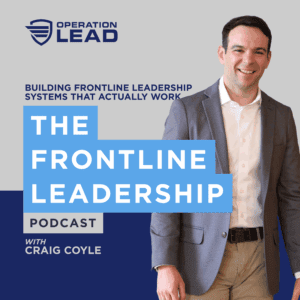
Over the coming weeks on The Frontline Leadership Podcast, we’re going to explore exactly how to inspire this change.
We’ll walk through the Lead Like a Pilot™ framework—a three-part system modeled after how professional aviators are developed in high-stakes environments, adapted for frontline leaders in manufacturing, operations, and beyond.
Here’s a preview:
- Flight School – Learn the foundational principles and mindsets of leading people
- Preflight – Master the routine processes that ensure safety and success
- Progression – Develop continuously with structure, guidance, and community support
Leadership can be taught. It can be systematized. It can be developed in anyone willing to learn.
But only if we stop leaving it to chance.
Take Action Today
If you’re reading this and something resonates, here’s what I want you to do:
Pull out your phone or a piece of paper and write down three things:
- One thing you’re doing well as a leader. (I promise there’s something. You’re here. That’s something.)
- One specific challenge you’re facing right now. Something at the top of your list as an opportunity to overcome.
- One thing you wish someone had taught you when you first entered leadership.
The first step in treating leadership like a profession is taking yourself seriously as a leader.
And if you want something practical you can use immediately, I’ve created The Leader’s Preflight Checklist—a tool modeled after how pilots prepare for every flight, adapted for frontline leaders preparing for every week.
It’s designed to help you communicate, engage, and activate your team week in and week out.
→ Download The Leader’s Preflight Checklist here.
If you’re a senior leader looking to build a systematic leadership development ecosystem in your organization,
→ Request to schedule a discovery call here.
The Bottom Line
Failing at leadership when you’ve never been taught how to lead is not a character flaw.
It’s a predictable outcome.
But here’s what I know: Every great leader had to start somewhere.
And if you study the greatest leaders who’ve maintained their impact over time, they all treat their leadership professionally. They grow. They learn. They seek mentorship. They surround themselves with peers who push them forward.
Next week, we’ll dive deeper into the Lead Like a Pilot™ framework and the three-part approach that helps leaders not just survive, but thrive.
Until then, remember:
Leadership isn’t something you’re born with. It’s something you build.
One intentional step. One day. One decision at a time.
Let’s Lead,
Craig